Understanding Racial Admixture in the Irish
Seated in front of the fireplace, Comrade Ossipon, ex-medical student, the principal writer of the F.P. leaflets, stretched out his robust legs, keeping the soles of his boots turned up to the glow in the grate. A bush of crinkly yellow hair topped his red, freckled face, with a flattened nose and prominent mouth cast in the rough mould of the negro type. His almond-shaped eyes leered languidly over the high cheek-bones. (Joseph Conrade, The Secret Agent, p. 41)
As we wrote some years ago, the Irish have an ancestry tracked back to the middle east — and dark-complected, curly haired, dark-eyed and dark-haired people — that is not present in England.
This happened because when farmers living in the middle east came into Europe, the proto-Semitic variant — dark curly hair, dark eyes, dark skin, low IQs — surged along the Portuguese and Spanish coast and made their way into Ireland, where they settled.
Consider those odd Irish DNA test results:
People with pre-Norman Irish surnames may possibly have North African/Middle Eastern DNA.
As an example, trace amounts of DNA from the South and East Mediterranean are identified in 23andMe autosomal results. Such specific areas are Arabian Peninsula, Coptic Egyptian, The Levant, Caucasian and Mesopotamian. Some samples are included in the “Activity Feed” section of this project (20 Feb 2022). Identifying the relevant segments of the autosomal data already collected is to be the next phase.
What could this mean? Most likely that DNA from those regions has flowed into Ireland for centuries, mixing with a steady flow of lazy people from Europe looking for an easy life on the island of potatoes and whisky, producing a hybrid of Semitic and European genetics.
We track the Semitic history of the Irish by first covering what most Europeans have in common, namely a mixture of hunter-gatherers, farmers, and nomads, but in the case of the Irish, those farmers were Semitic:
The ancestors of the Stone Age farmers began their journey in the Bible lands, where agriculture first began, and arrived in Ireland perhaps via the southern Mediterranean. They brought with them cattle, cereals, ceramics and a tendency to black hair and brown eyes.
You do not get dark hair and eyes without admixture with some other race, and given that the middle east has always had multiple groups, some of which were Asian hybrids with a touch of north African, it seems Ireland got the dark ones.
This is responsible for the “Black Irish” phenotype today. The middle eastern farmers who came to the rest of Europe journeyed from what is today Turkey, but the Irish got the farmers from closer to the Levant region.
Later, European-types ventured into Ireland, bringing with them lighter coloring, but the dark genes and primitive tendencies remained:
Whereas the early farmer had black hair, brown eyes and more resembled southern Europeans, the genetic variants circulating in the three Bronze Age men from Rathlin Island had the most common Irish Y chromosome type, blue eye alleles and the most important variant for the genetic disease, haemochromatosis.
However, this group likely came from the Southern part of Europe or the Mediterranean as well, because we see low Scythian ancestry in Irish and Slavs:
As you can see, dear reader, most of the Slavs (Belarusians, Poles, Ukrainians and many Russians) cluster with the Irish near the western end of the plot.
In fact, the classically Irish genetic disorder of haemochromatosis likely has later Slavic origins, not Celtic ones. This means that after the original settlement of Europe by nomads coming in from (but not indigenous to) Eastern Europe, later Eastern European populations share heritage with the Irish group, which could be explained by the Semitic origins of both groups.
In other words, the Irish are genetically different from Western Europeans. On top of that, they suffer from inbreeding-like effects caused by a small starting population and little ingress:
An additional method of identifying genomic regions that harbor rare recessive risk mutations is to study runs of homozygosity (ROHs). These are regions of the genome that have many consecutive homozygous single nucleotide polymorphisms (SNPs). Unrelated individuals would be expected to possess several different homozygous regions of varying lengths across their genomes. If these regions are identical-by-descent, then both haplotypes have been inherited from a common ancestor. If a rare variant is carried on this haplotype, it will now be present in a homozygous and potentially recessive state.
…It is not the case that the Irish population can be considered a population isolate; rather it is an outbred population that is relatively homogeneous with limited admixture (Hill et al., 2000). Evidence has previously been presented, showing slightly elevated levels of linkage disequilibrium and genome-wide homozygosity in Ireland when compared with neighboring British and European populations (O’Dushlaine et al., 2010).
In fact, the Irish are among the most isolated populations in Europe:
Our results indicate a subtle but clear genetic structure across Britain and Ireland, although levels of structure were reduced in comparison with average cross-European structure. We observed slightly elevated levels of LD (linkage disequilibrium) and homozygosity in the Irish population compared with neighbouring European populations. We also report on a cline of HD (haplotype diversity) across Europe with greatest levels in southern populations and lowest levels in Ireland and Scotland.
The original Irish were nothing like the more Nordic invaders who came later, but the original group persisted as we see through the consistent appearance of dark coloring in Irish people today. Ireland was formed by the hybridization of a brown Mediterranean race with the more European-like people to follow:
However, a large shift in genetic variation is seen between Ballynahatty and the three Irish Early Bronze Age samples, Rathlin1, Rathlin2, and Rathlin3, who fall in a separate central region of the graph along with Unetice and other Early Bronze Age genomes from Central and North Europe. These plots imply that ancient Irish genetic affinities segregate within European archaeological horizons rather than clustering geographically within the island.
Consider the Irish admixture chart showing the introduction of Bronze age people closer to the middle easterners of Semitc admixture who also potentially peopled Hungary:
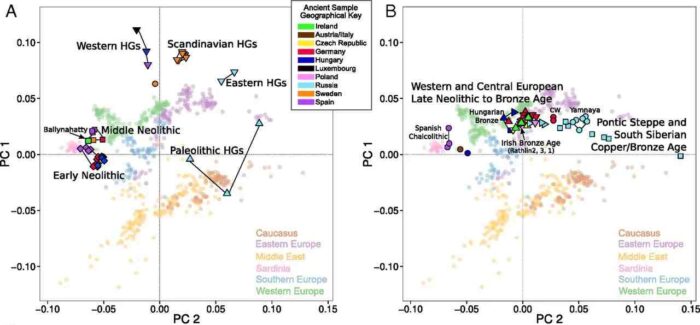
Even before the Bronze age, there was something “different” in Ireland, most likely the ancient Semitic admixture:
Ballynahatty shares the most alleles with WHG and furthermore has the strongest preference for WHG over EHG and SHG out of all contemporaneous Neolithic individuals so far sampled. However, Ballynahatty forms a clade with other MN genomes to the exclusion of WHG and, symmetrically, WHG genomes form a clade to the exclusion of Ballynahatty.
Contributions to the Irish genome may have come through a population which migrated along the coast of Spain, picking up Levantine and north African influences:
The Irish MN female farmer (3343–3020 cal. BC) from a Megalithic tomb in Ballynahatty near Belfast affords, to our knowledge, a first direct genetic view of the transition at Europe’s western edge. She displays predominant ancestry from early farmers that ultimately originated in migrating agriculturists from the Near East. This derivation is attested by her PCA and ADMIXTURE profile, her correlated allele frequencies with other Neolithic genomes, reflected in D statistics, and by her haplotypic affinity with modern southern Mediterranean populations such as Sardinians. Her early European farmer coefficient is estimated at ∼60%; an ancestry which is difficult to reconcile with extensive indigenous adoption of agriculture in Ireland only several hundred years earlier. She shares higher levels of genetic drift with Early and MN samples from Spain rather than those from Germany, supporting a link between the early farming cultures of Atlantic Europe and arguing for the possible passage of farming to Ireland via a southern coastal route rather than via the migrations through central Europe (2).
As summarized by scientists, this shows the genetic differences between Irish and English as well as all other Western European populations:
DNA analysis of the Neolithic woman from Ballynahatty, near Belfast, reveals that she was most similar to modern people from Spain and Sardinia. But her ancestors ultimately came to Europe from the Middle East, where agriculture was invented.
“Our finding is that there is some haplotypic [a set of linked DNA variants] continuity between our 4,000 year old genomes and the present Celtic populations, which is not shown strongly by the English,” Prof Bradley told BBC News.
In other words, the Irish are not Western European, which explains their persistent racial bias against Western Europeans and choice of third world style government instead of the Nordic style of institutional government:
In the middle of the 19th century — and Irish allegiance to the Democrats does go back that far — Boston politics were dominated by the tension between native-born Brahmins and immigrant Irish, whose numbers were increasing rapidly, especially after the Great Famine of 1845. Native Protestants feared that the influx of unskilled workers would bankrupt the city’s public-assistance programs and turn the neighborhoods where they settled into slums. Anti-Catholicism gave Protestant nativism a veneer of intellectual justification: Even leaving aside the problem of dual loyalties, they argued, Catholic doctrine is incompatible with the democratic virtues of self-reliance, independence, and freedom of thought.
Anti-immigrant sentiment became so virulent that in 1860 Abraham Lincoln accused Massachusetts Republicans — many of whom had been members of the Know-Nothing party only a few years earlier — of “tilting at foreigners” and undermining Republican support among German immigrants in the West.
One lasting difference between Republicans and the Boston Irish is on the matter of poverty programs, but the Irish tradition of welfare spending is almost as different from the modern Democratic party’s as it is from the modern GOP’s. By establishing the modern federal welfare state, Franklin Roosevelt destroyed the old machine system, the heart of Boston Irish politics for almost a century. When the federal government became the primary funder of social programs and public works, ward bosses were no longer able to offer material rewards to loyal supporters. The source of their power disappeared, and the machine ground to a halt.
In other words, Irish DNA bears out the behavior of their forebears from the middle east. Some Irish have also noted ancient North African results in their unmixed Irish bloodlines:
There seem to have been several Palaeolithic and/or Mesolithic migrations from Northwest Africa to Iberia.
We know that some of this north African drift occurred because we can see it in other Gaelic populations like the Scots who have traces of North African, perhaps migrating through Ireland:
Scotland’s DNA also found that more than 1% of all Scotsmen are direct descendants of the Berber and Tuareg tribesmen of the Sahara, a lineage which is around 5600 years old.
Interestingly, the Irish have a unique genetic identifier which serves as a modal haplotype of their melange of foreign origins and European influences:
Interestingly, during the course of this study we evaluated M222, a sub-R1b3 marker rarely used, and found that this sub-haplogroup in effect defines the Y-STR Irish Modal Haplotype (IMH).
However, in Ireland the influence of Nordic genetics appears to be less than in Western Europe:
We estimate that Norwegian (as well as Danish/Swedish) ancestry is also markedly low in Ireland (average 7%) compared with previous estimates (8, 9) (we explore this further in Discussion).
The north African drift may be part of the migration route from North Africa that went along the coasts but ended in Ireland, which is bordered by the Atlantic Ocean:
If we recall again the hypothesis that accredits the cultural dispersion to population movements, it is in order to offer an understanding for other studies, above all, genetic and linguistic ones, that support these connections of the North African world with the Iberian Peninsula during the recent prehistoric period.
The modern politics we think of as distinct from distant history are in fact the continuation of an ancient race war.
What we see in the Irish is an ancient foreign presence which has permanently distorted their DNA, explaining their grouping with the third world in failure to produce functional social institutions, warlord corruption, and blockheaded high time preference individualism.
In America, this manifested as an ancient race war which gave rise to our Civil War and continues to divide us politically to this day. Diversity itself is bad; any foreign DNA replaces your own, and you end up like the Irish.
Tags: admixture, diversity, irish, irish genetics, irish immigration




- Popular
- Crowdism
- Ethnomasochism
- The Increasing Mediocrity Of Everything
- The Alt Right Is Tired Of Living In Mordor
- Nihilism Is The Basis Of Conservatism
- The Nationalism FAQ
- Beyond the Absolute
- Conservationism Versus Environmentalism
- The Self-Inventing Totalitarian State
- The Biological Basis Of Race
- Whites Going Their Own Way
- How Individualism Defeats Conservatism