Graffiti
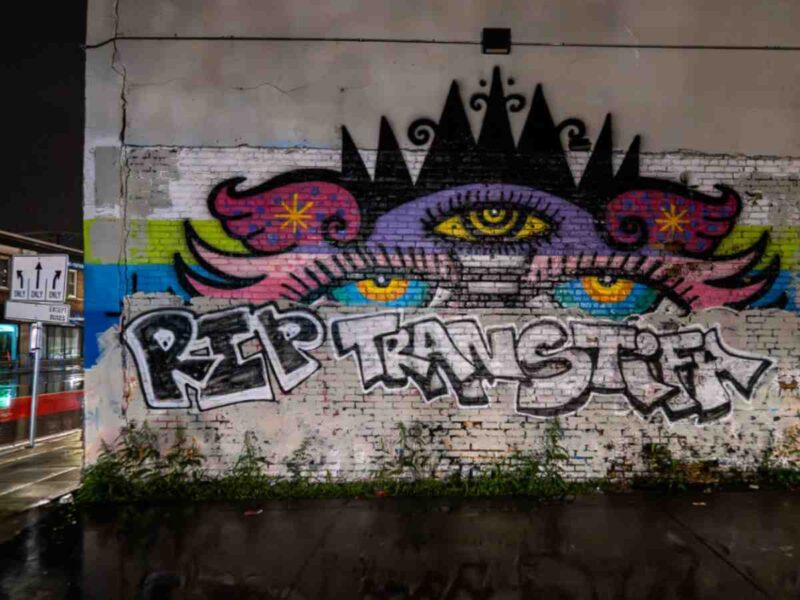
Driving through the city, one reflects on a fundamental truth: humanity is starving from a lack of significance. Individuals feel irrelevant and unimportant, a feeling that animals seem to have transcended, and so in the need to be involved in things, they vandalize their world.
This takes many forms. The graffiti on the old buildings is sad, but so is the relentless surge of academics and writers trying to bury the knowledge of the past under “new” ideas that were known six thousand years ago. The people who tear down classic architecture, replace functional things with plastic, and so on do this as well.
People of this nature seek to make themselves feel better by making their mark on the world and momentarily feeling powerful. The core of their emotions is envy, or the sentiment that if someone else has something good, it should be destroyed so that the envious person feels more relevant and significant.
Like gambling, obesity, drug addiction, and promiscuity, this only works for some time and then they need another hit. For a moment, they feel like a conqueror when they spray on obscenity on a wall or replace a functional theory with some product of their brains. But then the sensation fades.
The best societies suppress this. Or rather: the successful societies so far have suppressed it. The actual best will remove it in a Darwinian sense, exiling the people who think this way. As we are fond of saying around here, either the best oppress the rest, or the rest oppress the best (you are here).
As a result of this pathology, many if not most people make things ugly wherever they go. They will not admit to doing it consciously, but whether subconscious or not, they choose unsightly architecture, elaborate bureaucratic procedures, and moronic ideas and culture to vandalize their world.
Look down the freeway. A line of similar cars in a concrete trough, surrounded by square buildings that will not last a century, with lighted signs above it all demanding you buy some idea or object or another. Go to your boring job, pay taxes, put up with the red tape, and maybe you will get some watery beer and television.
It is hard to believe in any gods in this setting. After all, you are surrounded by ugliness. Life itself has become ugly, a matter of following procedure more than achieving results which could said to be beautiful. Any deviation prompts the crowd to retaliate, so we are all subjugated by group opinion.
To believe in any gods, you first have to believe that life itself is a worthy thing and in fact, is pleasurable and beautiful. Most people get it wrong, like they get most things wrong, and set up religions that are designed to vandalize reality and replace it with nice, easy symbols that feel solid in our minds.
Most human minds cannot conceptualize states of being except eternal life (perpetual present) or eternal death. To them, you are either alive here or in some proxy for here, or you simply do not exist. They cannot see the beauty which is the flexibility of nature, and how it delivers options of a less absolute, symbolic operation.
If we are surrounded by beauty, the continuity of everything makes sense to us: patterns recur, as if they came from somewhere else, and our consciousness is not our own creation, so we too are made by some bigger pattern elsewhere and will recur somewhere else, not in a perpetual present but a complex existence like we have now.
Those who prefer the ugly but tangible will always oppose this idea. To them, we must either be dead, or be what we are now — without growth, change, or new challenges — in some static state of infinite living death. They would rather have tight-fisted control over these mental images than accept the mystery of life.
Religion is misunderstood. Many think that without some ultimate purpose to human life, we would simply become mean and fraudulent and steal from each other. We point out that even without this ultimate purpose, people behave that way, and so do most religious people, so the ultimate purpose has limited utility.
What changes our thinking here is the recognition that life already has a purpose: to live. Living involves changing ourselves, adapting to overcome, and striving to make things beautiful; anything short of this may be existing but it is not living in the sense of being both a part of the world and autonomous.
Without gods, and without an afterlife, people would still choose to be decent because that is the only path to beauty and living. To get ahead in the short-term by being horrible means that in the long-term one must consider oneself to be an ugly thing, and self-vandalism reduces our power and enjoyment of life.
We are heavily demoralized not by government but by the victory of the moron horde. They will tear down anything good, beautiful, and real if they can and replace it with disposable plastic ersatz versions. Their goal is to assert ugliness over everything so that no one has what they cannot, namely a life of enjoyment.
This is why they insist on religions made of symbols hostile to known reality. They can control those, and these things are manipulations, like gestures (kissing babies) or appearances (possessions and status). To their minds, the ugliness must win by making us slaves to the Word or the symbol.
We can see how this is a reversed causation: instead of cause-effect, we think from the human symbol toward what we can rationalize according to it. If this were done by anything tangible, we would recognize it as slavery, and in the religious world, that becomes metaphysical servitude.
If we can look past the horrors of humanity, we can see that life for its own sake is good and contains the potential of beauty at every turn. This obviates religion and symbolism and replaces them with living for the sake of life, and only then can we glimpse the gods we might find meaningful.
Tags: beauty, fatalism, graffiti, religion, vandalism




- Popular
- Crowdism
- Ethnomasochism
- The Increasing Mediocrity Of Everything
- The Alt Right Is Tired Of Living In Mordor
- Nihilism Is The Basis Of Conservatism
- The Nationalism FAQ
- Beyond the Absolute
- Conservationism Versus Environmentalism
- The Self-Inventing Totalitarian State
- The Biological Basis Of Race
- Whites Going Their Own Way
- How Individualism Defeats Conservatism