The difference between readers will never cease to be fascinating. Like choice of car, cigarette, where you buy your house, what you feed your kids, and how you keep your desk organized, it reveals the conscious decisions of the individual.
Although this outlook may seem similar to the consumerist idea that you can buy a bunch of neat random things and be “unique” by “expressing yourself,” that symptom is actually the reverse of what is described in the paragraph above. In that view, you buy objects to fit your needs, and that reveals what you value.
In the false consumer variant, you buy objects to make yourself appear as if you have certain needs and values, and hope to construct yourself from those. It’s like painting a picture of what you wish you were like, and hiding behind it when introduced to people. It is similar to what an actor does, creating an ersatz persona.
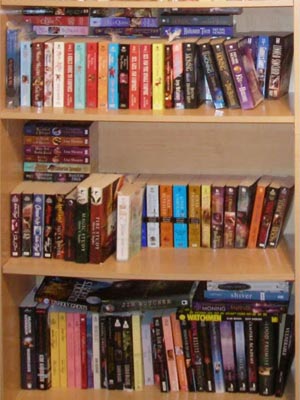
Through the bookshops in your city, and the bookshelves of the people who live in it, you can see this difference in action.
Start in the outer suburbs. These are people who forsake convenience in the city for having a nice place to raise kids. Lower crime, better schools, more space, fewer cars. Out here, you’re at first tempted to mock what they read. It’s Oprah book club stuff, on the surface. Trendy novels and dumb self-help books. A lot of contemporary Conservative literature with covers in red-white-blue only.
Skip that mess, then. Go into the city. Find a trendy urban neighborhood. Look at what people are reading there. On the surface, it’s more interesting. These are the books from the New York Times book list, the recommendations of Arts & Letters Daily, and the kind of hip stuff you see “intellectuals” talk about: Jared Diamond, Malcolm Gladwell, Michio Kaku, Howard Zinn, and some very nuanced novels.
Now compare the two by going under the skin. The outer suburbs have much bigger libraries. These libraries are actually more diverse in topic. They have all the crowd-pleasers (Stephen King, Ann Coulter, Lee Childs) but underneath that, there’s actually a huge variety of books on very specific topics. These are more like what you would find in a research library.
In the city, all of the books tend to be of the same type. For every five year cycle, there are about thirty books that urban pundits agree are profound. These are there in abundance. There is not much deviation from this list. It is almost as if everyone has the same bookshelf. They’re programming themselves with the same inputs.
The difference between surface and underlying structure is profound. In the suburbs, the surface is garbage, but underneath you see an intellectual life based on wide variety of topic area. In the city, the surface is shiny and provocative, but underneath you see very little actual dedication to learning. It’s more of a social circle, confirming its own opinions through the views of others.
Whenever people speak of “intellectuals,” you can use this simple litmus test. Are they explorers, or a group of people buzzing together with a hive-mind based on mutual agreement to what we could call social dogma? Our intellectuals today are the latter, which explains why they are always surprised by developments in reality that did not read the same thirty books as they did.
the city is filled with ayn rand
Detroit, MI wishes it were…
“Racism is the lowest, most crudely primitive form of collectivism. It is the notion of ascribing moral, social or political significance to a man’s genetic lineage — the notion that a man’s intellectual and characterological traits are produced and transmitted by his internal body chemistry. Which means, in practice, that a man is to be judged, not by his own character and actions, but by the characters and actions of a collective of ancestors.” – Ayn Rand
Ayn Rand was brilliant.
Agreed. And a school system that would allow 47% of it’s diploma-holders to graduate illiterate is a demonstration of the form of racism Former US President GW Bush called “the soft bigotry of low expectations.”
Just as any man is what he is: his character and all of his other attributes: he is, also, his race, his colour, his genes.
To offer him unnatural goodwill because he is not of one’s own race, is as racist, or more-so, than the one who responds in a natural way, whatever that way is.
The worst kind of racism is the kind that has one hating one’s own race, in favour of another.
Unconscious bias is far less malevolent than conscious bias.
And until the conscious bias of self-styled anti-racists declared war upon the unconscious bias of perfectly ordinary people, who were engaged in the everyday business of minding their own business, societies everywhere were far more benign than they have now become.
Racists are people who see racism everywhere, especially in their own race. They are unable to stop doing this, because to do so would seem, to them, to leave others unsure that they, themselves, were not racist.
Like anybody ever really cared, anyway, until the anti-racists started down a road of public one-up-man-ship.
Cheers to that, except somewhere around 50-60 percent of the “citizens” cannot even read
Great article!
It’s one of those observations that mostly never get observed.
I mostly never had a penny, in my life, and so was never able to buy much of anything. So anything I did buy was of the absolutely necessary kind.
I always imagined that if I could afford to, I would buy other kinds of things. Expensive, unnecessary things.
Now that I can afford to buy other things, I find – to my eternal amusement – that I still mostly don’t. I still only buy the bare minimum of necessities, in order to live a rather simple life. With a comparatively few luxury exceptions, here and there.
the whole “oprah book club bullhockey” is to help enrich leftist ideologues with the money of white women. most men, even SWPLs are less than interested in oprah’s opinion, it mainly applies to “liberated women”. so its good that old birds don’t stock their nest with “surviving bullying” and “a people’s history of the United States” (which is the most vehemently anti-caucasian, anti-christian and pro-geonocidal book ever written, which they by-the-way require some high schoolers to read)
I haven’t trusted this style of rhetoric ever since reading “You won’t find these ideas in a university library!” in a university library.
What’s trust got to do with anything?
Read it, consider it, put it to the test, reach your own conclusions.
If more people did that, then dogma could never gain a foothold :)
isn’t this somewhat of a “hive-mind” as well? (yes Ill be the asshole cynic), don’t we share simliar tastes in authors,ideas, etc. and don’t we ruthlessly destroy any “counter-arguements”? (incoherant leftist nonsense to be precise)
Hive-mind suggests going-along-with, without due consideration.
One thing you can say about conservatives is their characteristic of investigation, as opposed to ready acceptance of the most pleasant-sounding dogma.
Hehe that was funny :)
I made a typo: ‘dogman’ instead of dogma.
“Dogman”: one who emulates Pavlov’s Dog, in his slavering readiness for fresh Dogma.
thats a good point, really the established “schools of thought” demand allegiance to some kind of unrealistic, almost religious devotion to “equality”,etc. most of these people don’t understand that they are not thinking out of the box, but then again thinking out of the box is a good way to become unemployed, ostricized and the rest. most liberals are not “bad” people, just people adhereing to what someone is telling them, they are “proles” as denoted by the fact that they read what others tell them to read, rather than deciding for themselves. most younger people who happen to read/study “new-conservative”, “alt-right” material are doing so out of a sort of “rebellion” from the nihilism of leftism (in my opinion), but as long as we maintain open and realistic debates and thoughts then we ourselves will not become dogmatic (like “macarthian” anti-communists,etc.) side note: i fully agreed with macarthy by the way, he never-the-less justified leftist “moral superiority” in the 60s.
and the trailblazing efforts of the new-right are yet to be ready for the people that just “go along with it”
The Harvard Co-Op in Cambridge is the only bookstore in Massachusetts that carries Oswald Spengler, not to mention the entire Loeb Classical Library. As I was browsing around yesterday I heard noises of dissent from the crowd — college-goers calling Zinn a worthless hack, bright minds hassled by liberal dogma and looking for less ideological studies.
Hey, Avery! Welcome back to the fold :)
I was beginning to think you were “Away In A Manger…”
I flew back to Boston and don’t have my own computer… I’m composing a new post from a 10-year-old family desktop :)
On my nearest bookshelf:
Ride the Tiger by Julius Evola
ArcheoFuturism by Guilaume Faye
The Culture of Critique by Kevin MacDonald
On Genetic Interests by Frank Salter
End the Fed by Ron Paul
White Identity by Jared Taylor
Towards the White Republic by Michael O’Meara
Summoning the Gods by Collin Cleary
Other than ‘End the Fed’, I doubt you will find many of these in any public library or walk-in book store.
you don’t have mein kampf? tsk-tsk
Who wrote that? Harold Robbins?
waahahahaa! ;)
“For every five year cycle, there are about thirty books that urban pundits agree are profound.”
Just to satisfy my curiosity, where can I find this list? Is it in the New York Times?
Nevermind. I re-read the article and found the paragraph that clearly identifies the NYT as the source of the list.
My favorite intellectuals have always been subtly anti-intellectual, I think, or rough around the edges in a sense. Beware of any one who writes a little too properly! Nietzsche in particular comes to mind as being a sort of anti-philosopher philosopher. I’ve always preferred fiction and poetry to science and philosophy. I think the ultimate intellectuals are poets – William Blake, Walt Whitman, Holderlin.
And how could I forget Pentti Linkola? There’s a perfect modern example of a rough-around-the-edges intellectual. Love him. The first word in his book is “humbug.”
Bah humbug everyone!! ;)
It’s funny that when it all comes down to it, you’re judging people for having books which echo their own natural thoughts, while–wait. what was your point again? you should buy books that don’t jibe with you?
wait…wait. consumerism, conspicuous consumerism? I’m confused.
In the end you’re all buying books, to me, to confirm and validate yourselves and your ideals. Obviously you’re an “intellectual” so you have dogma. You just won’t admit it. It’s some sort of retarding paradox.
There are books we should read because they help us clarify and deepen our own views.
But there are also books we should read because they contain the best arguments for our opponents’ position — and we shouldn’t waste time arguing against the weaker presentations.
In both cases, we should always try to select the best. Life’s too short to read everything that’s out there.
The problem is figuring out which ones are the best and therefore worth the time it takes to read them. That kind of judgment and taste requires experience. To begin with, it’s a good idea to accept the guidance of a teacher.
It might also be a good idea not to concern yourself too much with contemporary writing until you have mastered the classics of your own tradition.
(Wishing for an edit button, so I could add this to my previous comment.)
What Brett is describing is people who take the crowd as their teacher, and let it point them to the “books worth reading”.
The problems with that approach should be obvious. The crowd’s mood and interests drifts and shifts abruptly, with no apparent goal except satisfying its idle curiosity and need to pass the time. The tastemakers who lead the crowd from one book to another, when they aren’t motivated by leftist ideology, have no pedagogical purpose in mind; their only concern is novelty and the status they get from being the first to call attention to something new.
I’m nearly at the end of Malcolm Gladwell’s Blink. I’m not sure if anyone recommended it to me or I just saw it on the web, but I got it under the impression that there would be some radical conservatism in the idea of “being able to judge a book by its cover”.
It’s interesting, but you can smell the unease caused by the liberal bias – that and I think the crux of his argument is stuff that’s just second nature to conservatives.