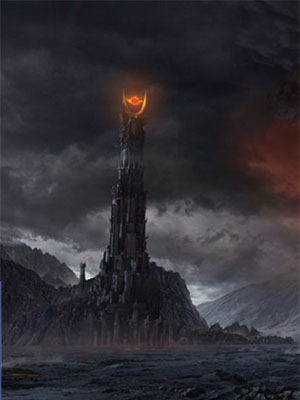
Mitt goes to Mordor to slay big government
Among the American right-wing, there’s a perception that government has become a parasite.

This is because government works for itself: it invents reasons to exist, expands to serve those reasons, and then repeats the process. While presidents have periodically whacked it back in the past, the overall theme is one of mission creep: a set of goals that expands spontaneously, consequently requiring more people, money time and laws.

Such governments are “facilitative” in that instead of trying to provide a stable nation alone, they focus on providing services to their population. Because they pander to the individual, and to the majority of individuals, they inevitably drift toward the left and into the welfare state and Social Marxism.

Since the 1960s, the scope of government has expanded at an unprecedented rate. Where the Americans of old viewed government as a means toward military safety, economic stability and international relations, the new government focuses on domestic issues. Specifically, it attempts to tax the rich to subsidize the poor and provide economic and social equality.

This divergence shows us the choice in election 2012. We either choose government as a background force that provides stability, or we style it as a social services provider that is a moral guide to our society. Conservatives feel that culture, religion and heritage should guide us, and government should stay out of these roles.

Many reasons exist for this choice. First, administration is at best bureaucratic and impersonal in its nature. It achieves results by finding the most hopeless cases and devoting itself to them, which “looks like” productive activity in resolving social problems. It also applies impersonal and distant rules designed for mythical “average cases” to individuals, driving them mad.

History is in fact littered with examples of the failure of the administrative and bureaucratic state. When you have great individuals in charge with a goal set by culture, heritage and religion, nations arise which reward the best in individuals and as a result shoot to the top. When the bureaucracy is in charge, it rewards the most obedient, which discriminates against the competent and sends it to the bottom.

The two directions of government reveal themselves in this split: organic culture (conservative) versus administrative ideology (liberal). The other axis is degree of force applied to achieve this aim, which is why the left is a spectrum from anarchist through liberal democrat all the way to socialist and communist. Conservative nations thrive for longer periods of time.

Voters on the right and not concerned about this recession only. They see this choice of paths as what will determine our future. Do we become more like the America and Europe of pre-1960s values, or do we become more like the former Soviet Union? European Socialism and American “Great Society” programs have led us in the latter direction for the last 50 years.

Mitt Romney started his campaign on neutral ground, talking about reforming the economy and getting people back to work. These are traditional GOP cheering points. In this election, however, the audience wants more. They’ve been paying attention to the Tea Party and Ron Paul, and while they don’t want to hand power over to those entities, they would like to see more influence from those bedrock conservative movements.

The audience is there to propel him to the presidency, but Mitt does not yet realize that they have given him a mandate to go into the Mordor of big government, which is necessarily “facilitative” or welfare-oriented and thus likely Socialist/Marxist or something like it, and slay that big government by restoring it to its conservative role as provider of stability and nothing more.

This election determines the future of America, and influences Europe as well. If the majority does not choose a conservative style government, it will be replaced. The leftist government will import new voters, or cultivate rootless and angry people through bad policy, creating enough liberal voters to permanently send the US on a course toward full Soviet.

Future historians will view this election as crucial. Either Mitt will win and go into Washington and replace the rising left-wing social government, or the leftists will win their 1960s goals and convert the West to socialism, after which only collapse — economic, social, political and cultural — remains. Here’s hoping Mitt is up to the job.

10 Comments

  1. Vigilance says:

    Should mitt be elected and all that you hope for brought to fruition, there will be many remaining liberals who will continue their fight. Perhaps what is needed is a full swing to the left? The collapse of the leftist society may be sufficient to rid ourselves of it. At which point the nation may be rebuilt. As we stand, regardless of the outcome of the election, we have far too many individuals who bow before the altar of Liberalism.

    1. Lisa Colorado says:

      So what you’re saying is, maybe we should steer into the skid? I’ve thought about that too. What you’re talking about, though, assumes best possible outcome for conservatism. However, I am 100 percent sure that if things were logical enough to fail from the leftist policies, those who believed in it would have an endless capacity to blame someone else, never looking at their thinking nor learning any lesson.

      I advocate for trying my hardest to listen to others or at least pretend to, and then try to stay calm and mature because arguing just invites positionalism. And I try to let the truth radiate and overcome the force of that emotional high people got from the Bbama speech. People are hypnotized, highly-suggestible, and the only answer to the devil is to reach out, poke your finger at its nose and laugh.

      As Saul Alinsky, Pbama’s philosopher said, it’s not what you’ve got–it’s what they think you’ve got.

      We can’t defeat the deluded and ignorant but we can resonate with the higher level people who still want to think.

      1. I think this sums up a rational response to the current political situation.

        They are on an emotional high, but that is like all transient things no substitute for a logical plan. We have the logical plan: we should deflate the illusion, bring up the plan, and keep pushing toward that goal.

        Mitt Romney may not be everyone’s ideal, but no candidate is. People in particular think he isn’t extreme enough. The point is that we change direction, and go rightward. If that succeeds, we go farther. The emotional high people will not agree, but they will also be marginalized by a rightward shift and will be less likely to respond with anything but radicalism. In the meantime, a rightward shift means that we get more of what we want and less of the failing left-wing policies that are slowly destroying everything they touch.

        It may not be as emotionally comforting as voting in an Obama, but voting for a Romney steadily moves our country back toward a path to sanity, and every sane person should support that.

  2. LuxLibertas says:

    Fool me once, shame on you. Fool me twice…

    …the fooled man can’t get fooled again.

    1. The Reagan, Bush I, and Bush II presidencies were the best in my lifetime. Fool me not again, I won’t vote Obama (not like I would have, given his low level of qualifications, absent data from crucial parts of his life, the fact that he and his wife are disbarred, etc.).

  3. jwthomas says:

    “Since the 1960s, the scope of government has expanded at an unprecedented rate.”

    Since 1960 Republican Presidents have served 7 1/2 terms (Nixon 1 1/2, Ford 1, Reagan 2, Bush 1, Bush 2); and Democrat Presidents 6 terms (Kennedy 1/2, Johnson 1 1/2, Carter 1, Clinton 2, Obama 1). And this suggests that Mr Romney, unlike the others, would not increase the size and indebtedness of government? Why is that?

    1. Your implicit assumption is that because Republicans have served 1.5 terms more than Democrats during the time when the scope of government has expanded at an unprecedented rate, Republicans are unlikely to slow the increase in the size and indebtedness of government. Let me clarify:

      1. Congress makes laws, and appoints agencies, not the President. (You can stop reading here; this is the crux of the issue.)
      2. The original post was about scope of government, which is related to mission creep.
      3. Size/indebtedness, while not a measure of scope, increase automatically unless cut back violently. Government is a huge employer with many branches.
      4. You do not take into account how much more unruly government would be without those Republicans. It’s possible that Republicans and Democrats cancel each other out, or that one is fighting a rearguard action against decay.
      5. The article doesn’t argue that Republicans are necessarily guaranteed to reduce government, but that Romney has the popular mandate among the right-wing voters to reduce government.

      1. jwthomas says:

        Thanks for your response.

  4. Mr. Salieri says:

    So what exactly do you mean when you say “background force that provides stability” and what exactly are the differences to providing sevices to the public, where dou you draw the line?
    I don ‘t really get the difference between, lets say, free police, and free fire fighters, which try to keep you and your properties safe, and free public health care, which does the exact same thing. Also, isn’t social equality crucial for social stability, since every revolution from the french revolution in 1789 to the arab spring in 2011 always spawned out of a situation of giant social inequality?
    And you say that “culture, heritage and religion should guide us”, what exactly do you mean by that, in which regions precisely should these factors take the leading role and where the government and why, and do you feel the modern businessworld is following those values of culture, heritage and religion?

    How do you explain, that the USA is, compared to the other big industrialized nations, the one with the greatest social inequality, smallest welfare state and biggest deregulation, but at the same time one of the least competitive ones?

    I excuse for grammatic or orthographic errors, i’m not an english native speaker.

  5. Mihai says:

    :))

    And I say that whoever gets elected, the situation will be the same, with no differences in essence. Just another democratic election, just like any other.

Leave a Reply

43 queries. 0.842 seconds