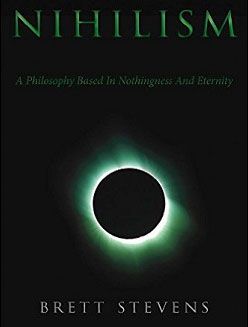
Can Life Prevail? by Pentti Linkola

Can Life Prevail? by Pentti Linkola
$25, Integral Tradition

Very rarely does a book make you feel good about receiving bad news. Usually, there’s something you fear so much that you want anything but to face it. But if someone is able to explain in clear steps what you must do to face it, and how the other side is indeed brighter, it lessens the burden. With decreased resistance and doubt comes greater effectiveness, and you may emerge with more triumph than suspected possible.

Can Life Prevail? is one such book. Since I was old enough to walk and perceive, it has been clear to me that something is very wrong with our world. Our adults are not focused on the task of living, but on the task of managing their self-image. Consequently, they ignore stupidities great and small. From the dumbness of school to the boredom and fear inherent to the workplace, to the poor design of everyday objects, to the inanity of our public culture and the transparency of our politicians’ lies, adults are oblivious. They are easy to deceive and are so distracted they are “shocked and amazed” any time their children have sex or take drugs, their politicians cheat them, corruption is found to be rife, etc. In short, our civilization is a ship with no one at the helm. Most disturbing is our effect on the environment; we can get more humans if we screw them up, but we’re short on extra earths.

Unlike most environmentalists, Pentti Linkola does not try to talk to us through the filter of denial and distraction. Instead, he levels with us as a Machiavellian scientist would: each additional person takes up space our nature needs, we have too many people, most are thoughtless oafs who destroy eternally beautiful things for temporary cash, and our modern laziness arises from the ease with which we interact with life through machines. In this collection of provocative essays, Linkola targets every sacred cow with an even-handed but unequivocal whittling down of our resistance to the obvious: our species is out of control and needs pruning, and the problem is too many individuals of low intelligence and character. Unlike most “environmentalist” books, this is not a hand-wringing or maudlin work; it is forthright, assertive, strong and also very funny as Linkola probes the ostensible logic behind our decisions and contrasts it with his observations from many years in the field as an observer of birds, fish and trees.

Linkola asserts a number of worthy points:

  • Habitat loss is more destructive than pollution;
  • Climate change is a vile problem resulting from lack of woodlands;
  • We can fix climate irregularities by re-planting forests we killed;
  • Domesticated animals destroy wild species;
  • Most people are careless and unable to be stewards to nature;
  • Democracy will not limit the selfish actions of individuals;
  • Human overpopulation is the driving factor behind habitat loss;
  • We are too distanced from nature, even the gross aspects;
  • Our machine-oriented mentality makes us lazy and weak.

At his best, Linkola is half scientist and half satirist, always nudging us back to a level of reality. If nature were a machine, he seems to say, we’d pay attention to signs of its decline. But it’s too complex for our point-to-point modern mentality, so instead we space out and hope for the best. Each of these essays picks an intriguing angle to its topic and explains it through a clear example, usually backing up observations with factual data from ornithology or the experience of a fisherman. As stated above, it gives hope by giving us a clear analysis of the problem that isn’t mired in ulterior motives or the greatest ulterior motive of all, “don’t rock the boat.” Where most green books offer you what’s basically a shopping guide for “green” products, Linkola goes further — not only by realizing that consumerism and environmentalism are incompatible, even if that consumerism is of a “green” kind, but by striking against our preference for all things human. He makes the point many times that we only consider human emotions and thoughts, and do not stop to observe our world. If it were named Steve and talked with a lisp, we’d respect it as equal. But outside the anthrosphere, nothing gains equality to us brave equal humans.

He brushes by the question of our reactions to, or judgments of, his ideas. Like a researcher he gives us the data and recommendations, and leaves it to us to react in private and then realize our reactions have nothing to do with nature; as history shows us, only what is effective matters. All of our fond notions and egalitarian sentiments, politics and politeness, feelings and validations are entirely irrelevant. What works matters. What is not part of that process is irrelevant and forgotten by time. I find this very comforting because our world normally has a stop-start rhythm where a new concept is uncovered and then we must all wait for the inevitable simian panic, outbursts and finally grudging admittance. This part of our monkey heritage disgusts me the most. There is none of it in Linkola. It is like reading a lab report on the fauna of the North Atlantic. It’s unusual to see humans treated like the other subjects we write about, but comforting in that it is purely logical.

There are parts of this book where I cannot get onboard the Linkola train. It’s hard to tell when he is provocateur and when he is prescribing a medication of lucid sanity, but in most cases, he seems to be serious and it’s hard to disagree. It shocks the average human when he rails on housecats as killers of birds, but when we think back on our own experience, we’ve all seen stray cats slaughter wrens by the bushel. I can handle that, and the idea of being less squeamish about day-old fish, but during the last few pieces, Linkola outlines more of his ideal for a society and it falls short. Primitivism is a neat idea on paper and would solve the problem, but lose so much of what makes us vital. Unlike Linkola, I cannot blame our machines for the fact that most people are thoughtless, destructive, short-sighted and corrupt. I think we need to realize that we like the wrens are biological creatures and just do as our instincts instruct. Perhaps another future thinker will suggest that those humans who do not have such frailties should prevail, and the others quietly go away, but Linkola stops short of calling for world eugenics on that scale.

Most importantly, Linkola says what so many of us think in private moments. There are too many of us, and too many idiots. If we keep growing we’ll kill everything. People sacrifice nature for short-term profit. Because most voters are idiots, we cannot control this process. The instant we try something constructive, a corrupt person will buy a few hundred thousand dollars of TV time and use it to sway the masses of useful idiots to do his bidding. As a result, our current civilization is like a speeding car with no brakes. We’re out of control and cannot stop. As we accept this, day after day, it kills us a little inside. Linkola is the antidote who removes our false pretense and the emotional manipulation of our fellow citizens, giving us instead a clear path to victory that true, must rocket through taboo and the herd fear of a mass of humans whose average IQ is barely 100, but nonetheless can be achieved if cooler minds prevail — and are willing to as relentlessly manipulate the masses as their ideological opposites.

Disclosure: Our author Brett Stevens wrote one of the introductions to this book. It was not reviewed. Our collaborator Vijay Prozak wrote a review here which was not used in the writing of this column.

Deconstructing our sense of self

A lot of what we do here at Amerika is to re-mix news articles. By changing context, we show you where the ideas discussed are applied. An idea by itself, in abstract, seems both universal and applied nowhere — an echo of our own self-perception, by which we are perceivers and only secondarily realize we also have bodies and are participants.

The first point we have for you today is the nature of language. We tend to think of it as a tool; however, it’s a tool that also shapes how we look at the world. When you have a hammer, everything’s a nail:

One researcher who has pioneered this theory is Professor Friedemann Pulvermuller, a language specialist at the University of Cambridge. He is particularly interested in the relationship between language and action, and supports the philosopher Wittgenstein’s view that language “is woven into action”.

It is well established that listening to action words such as lick, pick and kick activates the brain areas that control the tongue, hand and foot. Pulvermuller’s research goes a step farther, suggesting that the brain’s action system does more than respond to meaning — he believes that it contributes to it.

To test this theory, Pulvermuller ran a study in which he stimulated different parts of the action system using TMS while volunteers listened to tongue, hand and foot-related words. The level of TMS was enough to increase the neuronal activity, but not enough to knock out the region. He found that stimulating the hand region made people quicker to comprehend hand-related words, such as stitch and pick.

The Times

And how this tool effects us can be quite fascinating. For example, we pick ideas that are easier and consider them true. While this is the path of least resistance in psychological action, it’s also dangerous in that a half-truth is simpler and easier than a whole truth, and truths often include difficult things for us to accept personally and thus to wrap our minds around. So we discard them in favor of a simpler explanation, and claim it’s more truthful:

One of the hottest topics in psychology today is something called “cognitive fluency.” Cognitive fluency is simply a measure of how easy it is to think about something, and it turns out that people prefer things that are easy to think about to those that are hard. On the face of it, it’s a rather intuitive idea. But psychologists are only beginning to uncover the surprising extent to which fluency guides our thinking, and in situations where we have no idea it is at work.

Psychologists have determined, for example, that shares in companies with easy-to-pronounce names do indeed significantly outperform those with hard-to-pronounce names. Other studies have shown that when presenting people with a factual statement, manipulations that make the statement easier to mentally process – even totally nonsubstantive changes like writing it in a cleaner font or making it rhyme or simply repeating it – can alter people’s judgment of the truth of the statement, along with their evaluation of the intelligence of the statement’s author and their confidence in their own judgments and abilities. Similar manipulations can get subjects to be more forgiving, more adventurous, and more open about their personal shortcomings.

Because it shapes our thinking in so many ways, fluency is implicated in decisions about everything from the products we buy to the people we find attractive to the candidates we vote for – in short, in any situation where we weigh information. It’s a key part of the puzzle of how feelings like attraction and belief and suspicion work, and what researchers are learning about fluency has ramifications for anyone interested in eliciting those emotions.

Boston Globe

As you look out at that big world around you, remember this is how most people make decisions:

  • What they see first stimulates how they think about the decision. The tail can easily wag the dog.
  • What is easier for them and more pleasant is more likely to be what they pick as true. We filter the world before we figure it out

The result is decisions based on the convenience of the individual’s psychology. We first find what our brains like; from that set, we pick what might be the most likely answer, or at least the easiest. It would make more sense to filter less and consider our options more systematically.

Net neutrality: not what you think it means

As part of the progressive dumbing down of our society, we live by political “issues.” These are clever symbols for problems we need to solve. They are usually framed by whoever comes up with them first.

This framing puts a spin on them so that it’s hard to disagree. When one side calls itself “pro-life,” who are the others supposed to be? If one group of people decide they are pro-democracy, the implied adverse is that the other group is anti-democracy. Popular terms to use in creating successful spin: free, freedom, peace, love and neutrality.

Neutrality sounds good to us because it’s the absence of conflict. It also means an absence of bias, and with that, oversight. When we talk about neutrality, we talk about that moment when the teacher leaves the room “for just five minutes” and tells us to be good. Then the door closes and anarchy begins. Sure, the honor students study, but they’re so outnumbered if it comes down to the line they’re doomed in thirty seconds.

You’re going to see more of the word “neutrality” soon. As the topic of net neutrality again hits the news and the campaign trail, just about every pundit and his dog will offer an opinion on it. Most are going to take advantage of the fact that English is divided into dialects. There’s a technical dialect in which the term “neutrality” means a lot less than it implies in the terms you hear on the news.

In the technical dialect, “network neutrality” means no site can refuse to forward traffic to another. In the common dialect of the Oprah-watching Facebook-posting useless modern corporate feudal peasant, “network neutrality” means no oversight and that Big Daddy Government is going to stop ISPs from demanding we stop downloading gigabytes of horse anal porn when little old ladies need to check their email.

The internet works like a giant game of secret, but with a twist. Instead of passing messages straight across the room, you tell your the person next to you “Hey, tell Dave that he’s a fag.” They then tell the person next to them to pass that message to Dave, and it goes through a bunch of people before someone finally gets punched out.

Network neutrality means that Susie, who is running for class president against Dave, can’t suddenly decide to stop passing on messages to Dave. Engineers designed the internet to be flexible and resilient in case of attack, so that if the guy who sits next to Dave gets shot, the message can still reach Dave another way. The net only works because every site talks to every other site, in theory.

In reality, that’s inconvenient. If you’re a big media giant like CNN, and you make a deal with Comcast, you want people to be able to get to your site first and every other big media giant’s site second, if at all. A recent example can be found in the case of AT&T and Apple, who signed an exclusive agreement. If your testosterone drops and you buy an iPhone, you will be using AT&T service.

Network neutrality proponents hate the idea that if you sign up for one service over another, it limits the parts of the internet that you can connect to. However, there is nothing in network neutrality as a technical concept that implies ISPs have to let you keep downloading those gigabytes of midget rape porn.

ISPs still have the ability to offers tiers of service and to decline service to people who cost more than they are worth. Telling people that they’re fags causes fistfights and is the preference of only a small part of the population. There is no reason to guarantee you that “right.”

As with all concepts thrown at the feet of the thronging masses, network neutrality is a good concept that has been perverted into the usual demand. They’re expanding the definition of net neutrality from a technical one to the usual touchy-feely political bullshit. If you offer everyone the right to do whatever they want without oversight, they like it — and we all suffer when the teacher comes back into the room.

Heresies

I like to make lists. Sometimes I make lists of heresies. All heresies start with this precept: reality is different than dogma. That’s what makes them heretical; they offend dogma. If our leaders and fellow citizens tell us that something is true, and we point to a contrary example, we are heretics. In a “free” society, the dogmatics are not so much our leaders as our salesmen: the people in big media, corporations and your neighborhood social group who want to convince you to do things their way.

  • We give extreme negative power to the wrong people in this society. We reward the voice who shouts an epithet from the crowd, maybe “Communist” or “racist” or “elitist,” but never demand accountability for him. As a result, we deprive people of the ability to build especially in the areas where we most need construction.
  • Intelligence is relative. That means that people cannot understand an idea that requires more intelligence than they have in order to conceive of it. This is why we can “educate” people in behaviors, but unless they understand the cause/effect relationship about why those behaviors are superior, they are simply mimicking the original.
  • Creating misery. In a situation where objections stop change, no real change occurs, and so it treats us to dress up the same old stuff as new and then put some icing on it so the proles don’t notice.
  • We’re selling each other to death. Our culture has gone from a mode of “produce things” to “find ways to make other people like things.” We are now a culture of salesmen. The rest of the world moves on, produces things, knowing that at some point we’ll isolate ourselves and be selling each other the same stuff in a giant circle.

If you find yourself asking, “Why is modern life such a drag?” consider this:

  • Appearance is more important than reality. But that appearance needs to be positive in the sense of “someone wants to buy it,” but it can be ugly. It can be cheap. It can be crass. And you’ll have to drive past it every day.
  • When you assemble a large group of idiots, they buy idiot products — but no one except idiots from rich countries want to buy idiot products. The rest of the world needs function and if our wealth fades, we will have nothing to market.
  • You must tolerate idiots. It is heretical to suggest that idiots are, indeed, idiots and therefore should be removed from any functional process. Instead, we need to include them so we all feel good. It’s good marketing. “Everyone here is happy,” says the salesman. “We’re a big happy family.”
  • People who are not idiots get infected with the idiot virus brought on by having to sell things to idiots. They pre-chew every idea, break it down into tiny bits, and then tell you with bright pink faces how these tiny bits are more important than getting the whole thing right. Again with the salesman: “But it slices and dices!” Yes, but does it work? How long will it last? Is there a better way?
  • The essence of guilt is the idea of equality: I’m just like you, how could you turn on me? Take that from a reaction to a forward action and you have passive aggression: I’m just like you, I demand you do what I want! Only a society of salesmen could come up with such a moronic idea.
  • In a society where the greatest number of people must agree something is a good idea, and most of them are unaware of consequences past the next paycheck, you’re always going to get the short-sighted idea that hands everyone a bone while ignoring the real problem, which may take months or years to really stand up and slap us in the face.

Instead of going to either of the extremes — “I’ll do it their way” or “I’ll do it my way” at the expense of all else — just do it the reality way. That is the ultimate heresy. Idiots are idiots. Marketing does not improve products. Fast food restaurants, nail salons, record stores, head shops, convenience stores, cell phone places and charities are blight. So is producing nothing but repackaging the mediocre and numbing everyone’s brain by saturating them with marketing-speak. Do you want blight? No? Then exclude these from your life. Even if they tell you you’re a heretic. That’s just a sign you’re succeeding.

Ragnarok

Apocalyptic prophecies, as well as religion in general, easily garner an eye-roll from most everyone. What we see on the surface is an extravagant threat made to cow non-believers into fear of eternal damnation, or slaughter at the hands of forces above themselves; a desperate attempt to accrue validity to an ideology. Growing up, it was hard for me to understand this subject as little more than it was presented to me, and I was firmly of the belief that these veiled threats were meant only to be ignored. With adolescence came my insatiable desire to understand everything from an unbiased perspective, and this extended to religious thought. Now, as I enter young adulthood, I feel that religion was never meant to create a description of the end-times as much as outline the general flow of events that is decay.

The Norsemen believed that the end would be heralded by a magnificent battle against forces of chaos destined to replace order and morality. When we take a look at the world today, it’s hard to tell them that they’re wrong. Any sense of order or values is immediately regarded with suspicion by the majority populace. Still, people desire to visually and ideologically appeal to others as unique, and so they seek to adorn themselves with personal symbols that simultaneously do not insult our desire to not apply standards to anyone around us. Culture is appealing to these people, because the idea of being unique by being born into a culture creates a relatively easy method of standing out from the crowd. What this creates is a purely aesthetic understanding of culture.

In the past, culture was a conduit for tradition, which encompassed the goals and values of a people. Over time this tradition became engrained in the cultural aspects of a people, and so people born into that culture would be raised to interpret the world through their lens of tradition. The various religious and civil duties of a people would be designed to accomplish the goals defined by a tradition, and eventually the people would work towards accomplishing these merely by participating within the shared culture of their people.

Tradition insults people. It creates a standard by defining a course of action, and this is because those who are unable to follow that course of action are discarded or ignored. Obviously this can become a problem in a society that values diversity, as people who interpret the world through their tradition are inevitably going to hold the people they meet to the standards set by their traditions. This creates a tension between multiple cultures when one culture that does not understand the standards of another is brought under the scrutiny of them. When we defined the modern world as a multi-cultural world, we beset ourselves with the responsibility of creating a solution to this tension. The solution was reducing cultural values to a purely verbal or visual level.

When one thinks of Asian culture today, they think of Asian cuisine, like those eggrolls found in the frozen food aisle. They think of robed people with long hair and paper dragons dancing through the streets. They think of music played on Asian instruments, although not necessarily Asian in theme and purpose. If one is to become Asian, all they have to do is adopt these aspects – even if they only do so for a month or so. People decide to adopt the visual aspects of varying cultures as they appeal to them, or how they relate to their lives at that particular moment. There is no devotion to the traditions and goals of a culture associated with adopting these aspects, and no great amount of effort goes into the adoption process beyond the shopping spree that occurs at the local Earthbound Trading Company. If I can speak Asian, eat Asian food, and dress in the manner of an Asian, then I am Asian; as far as those who analyze culture with a shallow perspective are concerned.

This same surface-level adoption process extends to ideology. For the myriad of obscure problems we feel are facing the human race today, we have an equal amount of obscure solutions. We become so convinced that the world operates on the same single principle that unites the ideologies that we prescribe to that we spend more time promoting our ideology than living in a manner which improves the conditions that affect us. People will choose the ideology they associate themselves with based on how well they can disprove the ideology of others with it, and this belies our inability to understand anything outside of the social context created by our interaction with each other. What sounds witty (able to disprove the ideas of others) or altruistic (helpful to those we do not wish to be in the position of) all too often trumps simply living in a manner you know is effective and productive.

All of this stems from the same shallow interpretation of the world that reduces culture to a verbal level, and it reduces ideology to this same level. It is what reflects ourselves that we are concerned with, and truly we show little to no concern over the issues we so fervently discuss. I once discussed welfare with an acquaintance of mine for almost two hours before she finally informed me that she was insulting me out of her anger at how inferior she feels in comparison to me, rather than her concern for the issue at hand. We wear our ideas and our culture like clothing we buy at the department store. How meaningful do you find your t-shirt? If you are like most people, it is only something you wear until it doesn’t fit you anymore, after which it is immediately discarded. Is this how we should act towards issues that concern the well-being of our people and our families? What relevance will you proving your opinion correct bear on the proliferation of crime, or corruption?

For those who strongly adhere to their values, life can be truly frightening. Such people are subject to scrutiny from all directions, as their refusal to compromise their standards for the sake of tolerance is a threat to the peace of mind of their fellow citizens. Those who do not agree with these firm individuals will subject them to the same shallow discourse they engage in with others like themselves. They argue only to prove their authority in their own minds, and demonize the intelligent in the process, as intelligence implies an effective course of action which may not always be preferred. The choices of such intelligent individuals can even be perceived as useless in the face of such opposition, creating a sense of despair that so many actually concern themselves with such useless conversation. This assault on the courage of such people is only heightened as they witness the other banal pursuits that their peers elect to spend their time upon: methods of avoiding responsibility, self-gratification, and justification of activities that do nothing to advance the well-being of themselves and their community. With so many people unconcerned about their future, why should we even try?

It’s a harrowing question, but to those who strive to reach higher goals, one thing redeems the slow collapse of order, and that is purpose. Purpose is created when one defines a goal and focuses his actions towards achieving that end. For purpose to exist there must be an obstacle to overcome, and it is here that the Norse myth of the end times, Ragnarok, unveils its beauty.
When chaos surges forth across the world to claim it, it will be successful because of the lack of those with strong enough morale to fight it. But the Norse myths honor those who seek challenge, and thus seek to engage in life directly, and what better challenge than fighting a battle that seems overwhelming? This is a call to all the warriors of the world to fight against this challenge, and to keep the spirit of honoring life and creating meaning within it. It is a gift to those who understand what makes life purposeful to be confronted with these times. Many will feel tempted to become anachronistic, or to romantically pine for a better time, and these people have failed the challenge set before them.

At the end of Ragnarok, a time of understanding and wisdom descends upon the Earth, and the warriors who honored their traditions are hailed by their fathers in Valhalla, the realm of the Gods on high. These warriors are not people who literally praise Odin, although some of those people fit the mold; they are the people who maintain what they know is good, powerful, and meaningful in times when everyone has abandoned these things to recede into themselves. By fighting hard to gain positions of power, and spread their influence to others who feel lost, they have created a desire to build something positive in the wake of collapse that occurs around us. Their lifestyles prove through their results the positive results of their beliefs, and this will inspire generations of the intelligent who wish to find some sort of meaning in the world. This transcendent idea, of crafting an idea that carries itself out through generations, is the realm of the Gods themselves. By helping craft these ideas and beliefs, you are joining the Gods in this realm, and they will surely hail you for giving the fight of your life in the world of men.

New boss, same as the old boss

People think the media has changed rapidly. It’s the generational gap at work: Having graduated high school in the 1990s, I now think that what kids are getting into in the 2000s is insanity. Same will be true of people who are graduating now looking down at the class of 2020: “It wasn’t the same then”. One writer over at Boston.com finally broke through the social red tape and decided to tell it like it is:

A Catholic priest claimed that Superman “seems to personify the primitive religion expounded by Nietzsche’s Zarathustra’’ and said comics were a dangerous distraction from Christianity. A 1945 Time cover asked, “Are Comics Fascist?’’ Psychiatrist Fredric Wertham, employing some rather creative methodology, claimed that comic books influenced “the case of every single delinquent or disturbed child’’ he and his research team studied.

It seems quaint in today’s world of high-definition interactive violence and petabytes of free pornography that comic books could induce such hysteria. But they did, and we should pause occasionally to wonder how later generations will look at current efforts to rein in youth culture.

It’s useful, then, to place the concern over sexting into the broader context of youth culture hysteria. Just as was the case with comic books, many adults are reacting apoplectically to bits of technology or culture with which they have little familiarity. Like then, so-called experts try to convince us that kids today are more out of control than ever before. And like in the 1950s, misleading figures – often containing kernels of truth but conflating many unrelated elements – are broadcast at reason-suppressing decibel levels.

[+|Boston.com]

The idea being, “meet the new boss, same as the old boss”. The idea works for both media companies, who are always late to the game but retain just enough loyalty from herd-like creatures that they can afford to be perpetually late, and sexting as the author above describes.

The new boss is a type of site called a social news aggregator. This type, which feature commenting and voting/recommending, was made popular, in part, by sites like Reddit. People can vote up stories and try to get on the front page of the site, and there are circles of people – cliques, if you will – who vote up each other’s stories. Part of the reason to do this is to call “bullshit” but in a neutral piece of web space, and in standardized format.

The problem with traffic being diverted away from the Reddits and remaining at the larger media outlets themselves, is the idea behind a Reddit-type site is destroyed. If you post a Boston.com article on Reddit, anyone on Reddit from anywhere in the world can see it, and the more active (and one would hope, more intelligent) Reddit members would vote it up and comment on it as ideas about the article were discussed in an open forum.

Keep the discussion of a story or piece of news at the place from which it generates, and the quality of that discussion goes downhill. Now you’re mostly dealing with locals, and the company generating the content can decide whether or not to allow comments at all, or removing comments that are deemed unsuitable by way of generating too much controversy. In cases like these, a site like Reddit would normally take a much more hands-off approach than a larger media outlet “protecting the integrity of the interaction of its members”, or some such nonsense.

I wouldn’t call it a conspiracy, but rather business as usual: the larger, for-profit media outlets looking to sensationalize news stories but with a twist. Now they also want to control, as much as they can, how you react to that sensationalism.

Overnight

When you think about how any aspect of reality came to be, you realize there are several parts:

  • Groundwork
  • Causes
  • Media
  • Effects

Groundwork means the situation being set for a series of events to happen. For example, gasoline is often stored in cannisters in outside bars.

Causes refer to the exact chain of events that forced an event to transpire. Such as Billy Rob getting drunk as a coot, grabbing the shotgun and heading outside where he sees a possum and opens fire, not noticing his backdrop is the barn.

Media are the steps between the original cause and the event. For example, the barn fire was caused by the gasoline bursting into flame, which was caused by a gunshot. And the cause of the gunshot?

Effects are the event that transpires. Billy Rob blasts, the hot pellets tear through old sunbleached wood, the gas cannister ignites and the barn goes up in flames as Billy Rob passes out cold in the yard.

When something goes wrong with civilization, people momentarily “wake up” from their lives and their personality solipsism, and look immediately for someone to blame.

It’s like a drunk passed out in the street who comes to and found his wallet went missing while he was drunk. “Who screwed me?”

But really, these people are just agitating against the media, having finally noticed the consequences, and being oblivious to the cause and groundwork.

The groundwork: we are as a culture so obsessed with ourselves, our work and our pleasures that we push politics and leadership out of our heads.

The cause: a proliferation of parasites among us, and our determination to appear benevolent by ignoring, tolerating and even encouraging them.

Calcification, weight gain, bloat, decay, cancer… our metaphors all unite on one idea: the body has become an end in itself, instead of a means to an end, and so you get radical growth for its own sake, not for the health of the organism. The cells are all happy but the whole system is sick.

When we are inattentive, parasites proliferate. And in this world, there is never a time when you cannot be attentive, because the world is in constant motion. We are either headed for evolution or devolution, complexity or entropy.

There are no gray areas; there is, however, a pause between cause and effect while we wait for the signs of the effect to become visible, and we frequently mistake this for “no effect.”

If you listen to some charlatan, or even some neurotic self-deceiving person, they will tell you that this pause is proof that there are no effects for whatever self-serving ill-designed idea they’re foisting off on you.

Even more, they’re going to use social guilt to passively force you to accept it because — well, they want it. They’ll couch that personal want in terms of the abstract “Every One” or “Each Citizen” or “The Average Person,” but what they’re thinking of exclusively is what they want.

They are also not considering consequences, because they don’t care — they want what they want, and they want it now, because like the monkeys from which we originated, their intelligence is not developed enough to predict long-term intelligence. Consequently, they project themselves and their immediate need on every situation.

They will tell us that it is “none of your business” what they do, and that since they’re not directly murdering/raping/bombing they’re doing no harm, although they may be sinning by omission and by not doing the right thing, guaranteeing bad things will come about. Or by being selfish, they tear down and divide what is for their own gain.

Because they want us to re-designate “bad” as meaning “aggressive actions that change the status quo,” so that they can get away with whatever indirect or omissive sins they wish to commit, they will idolize pacifism, peace, conflict avoidance, benevolence, altruism and anything else that will keep the rest of us neutralized while they do their stealing and gaming of the system.

This is how parasites abuse society, and our inattention guarantees they will succeed, because by the time we wake up and see that overnight our society has transitioned to disaster, it’s too late for the kind of quick, sharp, painful and radical action that can avert the decay. It’s already underway and now requires a lot of labor to fix.

When we form a civilization, we immediately cease from struggling against nature to struggling against ourselves. Not everyone is born able to do what is right, and those that cannot or will not are determined to destroy that civilization — even if they don’t think they are, or claim they are not.

They are not autonomous; they are motivated by desires and pathologies below the level of the conscious mind. In the same way, homeless mental patients who come to live in your town “don’t mean to” invite in crime, but by providing cover for it — hey, it’s just another bum wandering around — and “borrowing” a few things here and there, urinating in a few alleys, breaking a few windows and creating a comforting environment for the alienated, they do perpetuate crime.

They’re the cause, not the media, which is the criminals who later arrive or the people who “suddenly” decide to act on their criminal urges. In the same way, parasitic people are the cause for corrupt politicians; they empower them by being willing to fall for any scheme, fear-mongering or ideology that allows parasites to keep doing what they want to do. This is why the most outrageous scams in history involve the words “freedom” and “equality.”

We should fight parasites because they don’t know what they do, and cannot do differently — they are pathological and broken. Although fighting them, and excluding them in victory, seems cruel, it is not because it allows that which is thriving to take their place. Imagine weeding a garden and removing the plants that threaten the productive ones — we aren’t any different from the plants. Some are born as healthy tomato plants, some as sick tomato plants, and some as weeds.

Promoting the strong, high character and high intelligence people allows us to continue evolving, growing and moving on to bigger challenges. After all, the stars await, and someone conceivably could write a better Ninth Symphony or Moby-Dick.

Focusing on the parasitic, or protecting the parasitic by focusing on the unfortunate or failed, guarantees that we will never get farther than we are now — and as time goes on, we will be beaten back by the world rushing past us.

Bad things do not happen overnight. They are not the result of predatory government or corporations — those are the medium through which they may appear to occur, but their origin is in good people being inattentive to the entropy-increasing actions of parasites.

The price of innocence is constant vigilance, and a willingness to destroy the parasitic.

Idealism

Idealism is the idea that order in the universe is not inherent but immanent.

That means that when patterns appear in our world, they occur from similar configurations of interaction of interconnected forces, like gravity plus energy transfer creating waves in our oceans.

Although that seems simple and obvious, it’s profound. On one hand it means there is no definitive intent behind the world; on the other, it means that all of it fits a design of vast complexity and that these patterns will always be with us, and we will eternally either adapt to them or suffer the consequences.

This sense of order emerging from life, as if the chaos of reality causes enough interactions that similar patterns become “beneficial” to the actors involved, much as how people flock to malls when there are coupons, directly contradicts both our old dualistic ideals and the relativistic ideals that replaced them.

The mystery has to do with a class of common events that can occur in full view, and share one key feature. In them, chaos inexplicably leads to greater regularity, or synchrony.

In certain experiments, “When you introduce disorder… the chaos that was present before disappears and there is order,” said Sebastian F. Brandt, a physics graduate student at Washington University in St. Louis.

World Science

In a dualistic view, some perfect pattern — heaven, or more recently, human wisdom — sets an ideal and life follows it.

In a relativistic view, parts of reality react to each other in predictable forms based on what each needs or seeks.

In an idealistic worldview, patterns emerge because matter, energy and thought are structured similarly, and the boundaries and tendencies of the information-demands of their structure determine probable patterns of outcome.

In other words, idealism explains order rising from chaos as being the result of all matter being shaped by the same patterns, and therefore, tending toward those patterns. Dualism and relativism have to rely on an absolute standard in which a tangible purpose, motivation or function is assigned to each actor.

But nature keeps surprising us, especially when we look hard at science and realize that our experience is shaped by our physical world, and not by the mathematical realities that may be out of our reach but nonetheless influence us:

There’s beauty in the world of condensed matter physics, if you know where to look.

Physicist Alan Tennant found it in the transitions between quantum states of cobalt ions cooled to temperatures near absolute zero and then subjected to high magnetic fields.

“At the exact point where you change from one state to another, that’s where you get the really important stuff,” he says.

“The quantum aspect of the system provides a kind of a simplification, and extra layer of order that you wouldn’t expect,” says Tennant

In fact, as they report in the journal Science, the order Tennant and his colleagues found was a kind of symmetry known as E8.

The point here, as Tennant says, is that in the weird quantum world, under certain precise conditions, an order in nature emerges that was previously unknown.

NPR

The idea that the properties of matter derive from information and pattern rather than inherent tendencies of matter upsets both the dualistic and relativistic worldviews. Interesting, these are more recent inventions — from 5,000 to 20,000 years ago, the ancient Hindus wrote about relativity in a way that suggested idealism.

Now, as we stagger back from humanism (the idea that human reason defines reality) and materialism (the idea that matter defines reality), we’re starting to rediscover the world of emergent patterns — and realize that contrary to dualism, they suggest no centralized control, but that also contrary to relativism, they suggest an order that does not change when we alter place, time or material.

Researchers from the Helmholtz-Zentrum Berlin für Materialien und Energie (HZB), in cooperation with colleagues from Oxford and Bristol Universities, as well as the Rutherford Appleton Laboratory, UK, have for the first time observed a nanoscale symmetry hidden in solid state matter. They have measured the signatures of a symmetry showing the same attributes as the golden ratio famous from art and architecture. The research team is publishing these findings in Science on the 8. January.

On the atomic scale particles do not behave as we know it in the macro-atomic world. New properties emerge which are the result of an effect known as the Heisenberg’s Uncertainty Principle. In order to study these nanoscale quantum effects the researchers have focused on the magnetic material cobalt niobate. It consists of linked magnetic atoms, which form chains just like a very thin bar magnet, but only one atom wide and are a useful model for describing ferromagnetism on the nanoscale in solid state matter.

Helmholtz Association of German Research Centres

The article above is another take on the previous research, but one which better explains the relationship between informational order, beauty, mathematics and the physical world which we experience from a human perspective.

It’s food for thought as we approach life itself. To know that the world is not a subset of our thoughts, and that matter does not have inherent tendencies, but the interaction of forces creates familiar (and repeatable) patterns — this should make us want to apply the scientific method in a new way, and think beyond the divine order of dualism and blank slate theory of relativism equally.

Toys for Modern Youth

When you shop for your loved ones this year, get them practical gifts that are both fun and prepare them for adult life in these times. We’ve put together a gift buying guide so you don’t have to feel helpless when gifting today’s youth.

Practice Birth Control Pills
Ages 6-11

These tiny candy pills resemble something your daughter will be getting to know sooner than later. With most girls sexually active by 12, and reaching the 25 partner point sometime by age 17, she’ll need to develop a routine of taking the right pill nightly. These brightly colored pure cane sugar pills will give her a little reward at the end of each day, and build that all-important habit of staying sterile. She’ll also feel like she’s becoming a woman when she, too, can take the pills her mother and older sisters live by. $24 for 12 monthly packs, comes with fake Planned Parenthood advice sheet.

Make-Work Desk
Ages 8-14

With good jobs few and far between, and our currency all but worthless (and falling fast), your precious amotivated snowflake is most likely going to end up in an entry-level job for most of his or her life. That is, if they don’t get hooked on drugs and become permanent food service employees. You can develop good habits with our Make-Work Desk, which both delights youngsters and teaches them early to look busy and if they’re not busy, to invent something good. Realistic reference manuals, a multi-line phone, drawers to clean and our handy 1.2mhz “Crashing Again” computer will show them how to always look busy, even when they like their coworkers put in 15 minutes of work a day and spend the rest of time in meetings, on the phone, or self-stimulating. $149, with Crashing Again computer $249

Young Partier DUI Field Test Practice Kit
Ages 6-12

With the way they grow up these days, it’s only a few more years before your child will drink to excess — and drive home. Why not start them early on dodging the cops? This easy home kit lets you set up a DUI (“Drunk Driving”) Field Test just like the cops do at the roadblocks. See how many drinks your youngster can down while practicing the alphabet backwards, walking a straight line, touching her nose with eyes closed and stepping through the complex patterns that law enforcement officers use to test for drunkenness. This makes drunk driving not only fun, but potentially saves your child thousands of dollars yearly that could be spent on hookers and blow. $39, additional breath mints $2

Sing-A-Long Excuses CD
Ages 4-21

If your civilization is dying, only the real losers take it at face value. Whether at school, on the job, in front of a Congressional investigation, or simply trying to dodge all the losers, fakes, parasites and jerks they’ll meet on a daily basis, your child needs to learn to sing like a bird — sing out lies, excuses, deflections and evasions, that is! Our long-playing CD sets common verbal gambits to song to make these classic excuses easy to remember, and to help children someday invent their own variants for whatever responsibilities they have to dodge. Children glow as they sing along with our mournful blues ballad, “Doctor Says I Ain’t So Well Today,” and they really come alive for the reggae-themed “No One Told Me (This Was My Job)” as well as the heavy metal ripper “Can’t Talk Now, Have an Organ Transplant.” If you start them out early with this informative and catchy CD, you’ll make winners in our future goes nowhere economy. $12

Interview: Taylor Somers of Occident

Post removed.